



En




After describing in detail the Chaturthi Kalpa, Sumantu Muni said to King Shatanika - "O King! Now I will describe the Panchami Kalpa; listen attentively. The Panchami Tithi is extremely dear to the Nagas, i.e., serpents, and is the giver of joy to them. On the Panchami Tithi, a special festival is celebrated in Nagaloka. On this day, whoever bathes the Nagas with milk, all these great Nagas, Vasuki, Takshaka, Kaliya, Manibhadra, Airavata, Dhritarashtra, Karkotaka, and Dhananjaya, grant fearlessness to his lineage, and his family remains protected from the fear of serpents.
In ancient times, due to the curse of their mother, all the Nagas began to be burned. Therefore, to alleviate the pain of that burning, even today people bathe the Nagas with cow's milk on the Panchami Tithi. By doing so, one becomes free from the Sarpa-Bhaya, i.e., fear of serpents."
The King, out of curiosity, asked - "O revered sage! Why did the mother of the Nagas curse them, and how were they protected? Kindly describe this in detail."
Sumantu Muni replied - "O King! This is an account of ancient times. Once, according to the instruction of Lord Vishnu, the Devas and the Daityas jointly churned the ocean to obtain Amrita. From the churning of the ocean there emerged a horse of extremely white complexion, whose name was Uchchaihshrava. Upon seeing Uchchaihshrava, the mother of the Nagas, Kadru, said to her co-wife Vinata - 'This horse is white in color, but its hair appears to be dark, that is, black.' Hearing the words of Mata Kadru, Vinata said - 'This horse is neither completely white, nor dark, nor red in color.'
Hearing this, in anger Mata Kadru said - 'If that is so, then make a wager with me. If I prove that the hair of the horse is black in color, then you will become my maidservant; and if I fail to prove it, then I will become your maidservant.' Vinata accepted this vow of Mata Kadru. Both, in a state of anger, departed to their respective abodes. Kadru narrated the entire incident to her sons, the Nagas, and said to them - 'O sons! Assume a form as subtle as the hair of the horse and cling to the body of Uchchaihshrava, so that he may appear black in color, and I may defeat my co-wife Vinata and make her my Dasi, i.e., maidservant.'
Hearing such words from their mother, the Nagas said - 'O Mother! Whether you win or lose, we shall not engage in such deceit. To gain victory through deception is a grave sin.' Hearing the words of her sons, Kadru became enraged and said - 'You disobey me; therefore, I curse you that when King Janamejaya, born in the lineage of the Pandavas, performs the Sarpa-Satra, all of you shall be reduced to ashes in the sacrificial fire.' Having pronounced the curse, Mata Kadru became silent.
By their mother's curse, all the Nagas became distressed and fearful, and along with Vasuki they appeared before Lord Brahma. The Nagas informed Brahma of the entire sequence of events. Hearing their distress, Brahma said - 'O Vasuki! Do not be anxious. In the Yayavara lineage, a very great and austere Brahmin will be born. He will be known by the name Jaratkaru. You should give your sister, who is also named Jaratkaru, in marriage to that Brahmin, and gladly accept whatever he says. From Jaratkaru's womb, a renowned son named Astika will be born, who will stop Janamejaya's serpent sacrifice and protect you, Nagas.' Hearing these words from the mouth of Brahma, Naga King Vasuki and all the Nagas became extremely pleased, offered their salutations, and returned to Nagaloka."
After narrating the above account, Sumantu Muni said to King Shatanika - "O King! This Sarpa Yajna, that is, the serpent sacrifice was performed by your father, King Janamejaya. Lord Shri Krishna also described this account before Yudhishthira, saying - 'O King! After one hundred years from today, the Sarpa Yajna will take place, in which extremely large and venomous wicked serpents will be destroyed. When millions of serpents begin to burn in the sacrificial fire, at that time the Brahmin named Astika will stop the Sarpa Yajna and protect the Nagas.'
The day on which Lord Brahma granted the boon for the protection of the Nagas was the Panchami Tithi, and Astika Muni also protected the Nagas on Panchami; therefore, the Panchami Tithi is extremely dear to the Nagas. On the occasion of Panchami, after worshipping the Nagas, one should pray - 'May those Nagas who dwell on the earth, in the sky, in heaven, in the rays of the sun, in lakes, in ponds, and wells, all be pleased with us; we repeatedly offer our salutations to them.'
सर्वे नागाः प्रीयन्तां मे ये केचित् पृथिवीतले।
ये च हेलिमरीचिस्था येऽन्तरे दिवि संस्थिताः॥
ये नदीषु महानागा ये सरस्वतिगामिनः।
ये च वापीतडागेषु तेषु सर्वेषु वै नमः॥
Sarve Nagah Priyantam Me Ye Kechit Prithivitale।
Ye Cha Helimarichistha Yeantare Divi Sansthitah॥
Ye Nadishu Mahanaga Ye Sarasvatigaminah।
Ye Cha Vapitadageshu Teshu Sarveshu Vai Namah॥
Thus, after bidding farewell to the Nagas, one should feed the Brahmins and then partake of food oneself along with family members. One should first eat sweet food and thereafter eat according to one's preference.
In this manner, whoever duly worships the Nagas on the Panchami day ascends a noble celestial Vimana and goes to Nagaloka. Thereafter, in Dvapara Yuga, he is established as a mighty, disease-free, and glorious king. Therefore, the Nagas should be worshipped with Ghee, Payasa (Kheer), and Guggulu."
King Shatanika asked - "O best among sages! What is the fate of a person who dies from the bite of an enraged serpent? And for the deliverance of those whose parents, brothers, sons, or others have died from snakebite, which Vrat, charity, or fast should be observed? Kindly describe."
Sumantu Muni replied - "O King! A person who dies from snakebite attains a lower state and is born in the womb of a non-venomous serpent. One whose parents or others have died from snakebite should observe a fast and worship the Nagas on the Panchami Tithi of the Shukla Paksha in the month of Bhadrapada for their liberation. This Tithi is said to be highly meritorious. In this way, for twelve months one should eat only once on Chaturthi Tithi and observe a fast on Panchami while worshipping the Nagas. One should draw the image of a serpent on the ground, or make a serpent of gold, wood, or clay, and on Panchami worship it with Karavira, lotus, jasmine flowers, fragrance, incense, and various kinds of Naivedya. Thereafter, five noble Brahmins should be fed with Ghee, Kheer, and Laddus. Ananta, Vasuki, Shankha, Padma, Kambala, Karkotaka, Ashvatara, Dhritarashtra, Shankhapala, Kaliya, Takshaka, and Pingala, these twelve Nagas should be worshipped in sequence.
After observing the Vrat and worship in this manner for a year, one should perform the Parana, i.e., concluding rite of the Vrat. Many Brahmins should be fed. A learned Brahmin should be given a golden serpent in charity. Thus, the Vrat should be completed with Udyapana."
Sumantu Muni further said - "O King! Your father Janamejaya also performed this Vrat for the deliverance of his father Parikshita and donated a very large golden serpent along with many cows to the Brahmins. By observing the Vrat and worship in the above manner, he was freed from the debt to his ancestors, and Parikshit attained an exalted realm. You too should likewise make a serpent of gold, worship it, and donate it to a Brahmin. By doing so, you too will be freed from the Pitri Rina, that is, ancestral debt. O King! Whoever performs this Naga Panchami Vrat, even if he dies from snakebite, will attain auspicious realms; and whoever listens to this Katha with devotion, in his lineage there will never be fear of serpents. By observing this Panchami Vrat with devotion, one attains noble realms."
॥Iti Shri Naga Panchami Vrat Katha Sampurnah॥
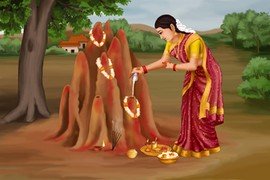
According to the Hindu calendar, Shukla Paksha Panchami of the Shravana month is celebrated as Nag Panchami. On Nag Panchami day married women offer Puja and milk to Snake God and pray for the well-being of their brothers and family.
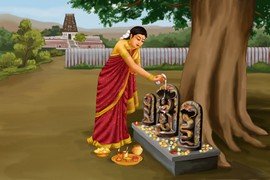

Sahasranamavali of Nag Devata, containing the above Mantras, is provided on this page.

The Nag Stotram dedicated to the Nag Devata is given with Sanskrit lyrics. This Stotram is also known as Sarpa Stotram.
According to the Amanta Calendar prevalent in Gujarat, the festival of Nag Pancham is celebrated on Shravana Krishna Paksha Panchami. In other Indian states, this festival is celebrated as Nag Panchami on Shravana Shukla Panchami. In Gujarat, Nag Pancham is celebrated fifteen days after Nag Panchami prevalent in other Indian states, which occurs three days before Janmashtami.
The festival of Nagula Chavithi is primarily celebrated in Andhra Pradesh and certain regions of Karnataka. It is observed on the fourth day after the Deepavali Amavasya, following the festival of Diwali. On this day, Nag Devatas are worshipped with devotion.

Beautiful Nag Panchami Rangoli designs, also known as Nag Panchami Kolam, are given for the occasion of Nag Panchami. These Rangolis are presented step-by-step with illustrations, making it easy for anyone to create them at home.