


En


Lord Vishnu holds an important place in Hindu pantheon. He is a primary deity in Panchadeva Upasana. Lord Ganesha, Goddess Durga, Lord Shiva, Lord Vishnu and Lord Surya are the five most important deities in Hinduism. Devotees who worship Panchadeva or the five deities, are called Smarta. Whenever the need presents itself, Lord Vishnu descends on Earth in various incarnations.
In the same vein, Lord Vishnu incarnated on Earth in the form of Narasimha. The word Narasimha is the compound word of Nara, which means man and Simha, which means lion. Hence, the literal translation of Narasimha will be man-lion. The description of Narasimha Avatara is found in many religious texts including Vishnu Purana and Bhagavata Purana.
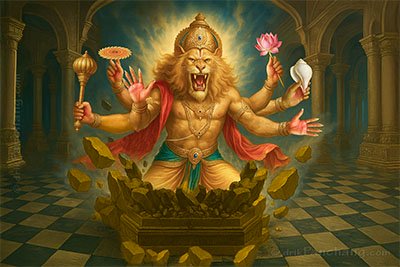
It is believed, Narasimha is the fourth incarnation of Lord Vishnu. He is also known with names such as Narahari, Ugravira, Mahavishnu among others. According to the account found in scriptures, Lord Vishnu incarnated in the form of Narasimha on the Chaturdashi Tithi of Vaishakha Shukla Paksha. Therefore, the devotees of Lord Vishnu celebrate this Tithi as Narasimha Jayanti. Narasimha is also written as Nrisimha.
Once, Lord Vishnu was reposing in Vaikuntha Loka. Jaya and Vijaya, the divine sentries were guarding the gates of Vaikuntha. After some time, Sanakadi Rishis, that is Sanaka, Sanandana, Sanatana and Sanat Kumara arrived there to meet with Lord Vishnu. Just when Sanakadi Rishis were about to cross the doorway of the Vaikuntha, Jaya and Vijaya stopped them. Seeing Jaya and Vijaya blocking their path, Sanakadi Rishis introduced themselves and requested to let them meet with Lord Vishnu. The Rishis made various entreaties to let them enter but Jaya and Vijaya adamantly refused their requests.
Sanakadi Rishis were enraged by the disrespectful behaviour of Jaya and Vijaya and cursed them - "Although you live so close to Lord Vishnu, your hearts are filled with pride and arrogance, and thus you are not suitable to live in Vaikuntha, the divine abode of Lord Vishnu. Thus, we curse you that you both will be born as demons and suffer the consequences of your actions." Upon hearing such harsh words, Jaya and Vijaya bowed down at the feet of the Rishis and begged for mercy.
At that moment, Lord Vishnu, along with Goddess Lakshmi and His courtiers, arrived at the gates of Vaikuntha to welcome Sanakadi Rishis. Upon learning about the entire matter, Lord Vishnu requested Sanakadi Rishis - "O sages! Jaya and Vijaya, the gatekeepers of Vaikuntha, are my courtiers. They have become arrogant due to their ignorance and disrespected you. But you are the crest-jewels among sages and revered by all. Their irreverence has dishonored not just you but Me as well. Hence, you have appropriately punished them. They have shown contempt to Brahmins and dishonouring Brahmins is equivalent to dishonouring Me. O great sages! I humbly seek your pardon on behalf of my two courtiers. In this world, the master is considered equally accountable for the wrongdoings of his servants. Therefore, I pray for your forgiveness."
Upon hearing such earnest entreaties of Lord Vishnu, the anger of Sanakadi Rishis instantly vanished. Sanakadi Rishis, elated with Lord Vishnu's kindness, thoughtfully said - "O Lord! You are the embodiment of Dharma yet bestows such respect upon Brahmins. O Lord of the three worlds! We feel deep remorse for our words because we cursed your beloved courtiers in rage. Therefore, we must seek your forgiveness. O Lord of compassion! You are omnipotent! If you find it appropriate, kindly grant forgiveness to these gatekeepers and release them from our curse."
Lord Vishnu said - "O sages! Even though I am omnipotent, I don't want to let the words of Brahmins become ineffectual. In fact, your curse is a part of my divine scheme. My courtiers Jaya and Vijaya will be born as demons for three successive lifetimes, and I shall incarnate to liberate them from your curse. They will always meditate upon my name despite harbouring extreme animosity towards me. I will slaughter them in the end and consequently they will regain their position as my courtiers in Vaikuntha."
In accordance with Lord Vishnu's divine proclamation and the curse of Sanakadi Rishis, Jaya and Vijaya took birth as the sons of Maharishi Kashyapa and Mata Diti. Kashyapa named his sons Hiranyakashipu and Hiranyaksha. After their birth, both demons began to grow at an astonishingly high speed and soon assumed the form of fearsome, gigantic demons. Hiranyakashipu performed intense penance to propitiate Lord Brahma and received a boon from Him that his death should occur neither during the day nor at night, neither within nor outside a building, and by no weapon of any kind.
After receiving the boon from Lord Brahma, Hiranyakashipu, intoxicated with his power, ruthlessly established his reign on three worlds. In due course, Hiranyakashipu's wife gave birth to a son who was named Prahlada. Hiranyakashipu considered Lord Vishnu his enemy, thus he always tortured and persecuted the devotees of Lord Vishnu and forced them to worship him instead.
On the contrary, Hiranyakashipu's son Prahlada was a devout follower of Lord Vishnu, constantly immersed in His worship and contemplation. He would ceaselessly chant the name of Lord Vishnu and inspire other demon children to worship Lord Vishnu as well.
When Hiranyakashipu learned that Prahlada devotedly worshipped Lord Vishnu, he threatened him in various ways to relinquish his faith and devotion in Lord Vishnu. But Prahlada did not deter from the path of devotion. On the command of Hiranyakashipu, his soldiers left Prahlada to be trampled over by elephants, pushed him off the cliff, chained him among venomous snakes, but Lord Vishnu always saved His devotee from any suffering.
In the end, Hiranyakashipu requested his sister Holika to help him. Holika was a demoness who propitiated fire deity Agni Deva and received a divine shawl from Him as a boon. Because of the boon, Holika's shawl could protect anyone from burning when exposed to fire. Therefore, at the behest of Hiranyakashipu, Holika, wrapped in the divine shawl, sat atop a pyre with Prahlada seated on her lap. But, as soon as the pyre was lighted, a powerful gust of wind caused the divine shawl to slide off Holika and fall over Prahlada. As a result, Holika was reduced to ashes in the flames meant for her nephew, while Prahlada emerged unharmed.
Upon witnessing the painful end of his sister's life, Hiranyakashipu was filled with such a fervid rage that he charged to slay his own son and thus roared - "O wicked Prahlada! Who will save you now from my wrath, call your Vishnu, let me see how powerful He is."
Bhakta Prahlada said - "Lord Vishnu is omnipresent, every living and non-living thing in all three worlds is part of His essence." Hiranyakashipu ridiculed Prahlada and said - "What did you say, every particle is part of His essence? Does He dwell in this pillar too? If yes, then He should come forward." While saying this, the evil demon Hiranyakashipu charged forward to strike the pillar, but at that very moment, Lord Vishnu appeared in the form of Lord Narasimha. He had a fierce form with the head of a lion and the body of a human. Lord Narasimha had big sharp claws and fangs and He was burning with rage and His breaths were issuing thunderous roars like flames of fire. The appearance of Lord Narasimha in such a fierce form caused uproar among the demons present in the court of Hiranyakashipu.
Just as Hiranyakashipu charged towards Lord Narasimha to attack, Lord Narasimha lifted him and carried him to the Dehali, i.e., threshold of his palace. Thereafter, Lord Narasimha had that demon lie on His thigh and said - "Neither it is day nor night, neither you are inside nor outside of your palace, nor will I slay you with any weapon." While saying this, Lord Narasimha tore open the abdomen of Hiranyakashipu with His sharp claws and wrapped his entrails around His neck as garland. As soon as Lord Narasimha slew Hiranyakashipu, various acclamations of victorious joy erupted from every direction and Gods from heaven showered flowers to celebrate the end of evil.
In this way, Lord Vishnu incarnated as Lord Narasimha to save humans as well as Gods from the tyranny of the demon Hiranyakashipu.
Goddess Lakshmi is shown as the divine consort of Lord Narasimha and together they are worshipped in the form of Shri Lakshmi Narasimha.
Lord Vishnu's Narasimha Avatara is Aveshavatara, that is when He incarnates to fulfill a specific purpose. Therefore, Lord Narasimha is depicted in an extremely fearsome form. In most visual representations, He is shown ferociously tearing open the abdomen of Hiranyakashipu. He is often portrayed with four arms, six arms and ten arms. In His six-arm form, He holds a conch, a discus, a mace and a lotus flower in four arms, while His two arms are shown tearing the abdomen of Hiranyakashipu. He has the head of a lion and the body of a human. He has sharp claws and fangs. He adorns His neck with the entrails of Hiranyakashipu as garland.
In other representations, Lord Narasimha is shown with Bhakta Prahlada seated on His lap.
In different regions, Lord Narasimha is worshipped in different forms, such as -
General Mantra -
ॐ नृम नृम नृम नरसिंहाय नमः।
Om Nrim Nrim Nrim Narasinhaya Namah।
Ugra Narasimha Mantra -
ॐ उग्रं वीरं महाविष्णुं ज्वलन्तं सर्वतोमुखम्।
नृसिंहं भीषणं भद्रं मृत्युमृत्युं नमाम्यहम्॥
Om Ugram Viram Mahavishnum Jvalantam Sarvatomukham।
Nrisinham Bhishanam Bhadram Mrityumrityum Namanyaham॥
Narasimha Gayatri Mantra -
ॐ वज्रनखाय विद्महे तीक्ष्णदंष्ट्राय धीमहि।
तन्नो नृसिंहः प्रचोदयात्॥
Om Vajranakhaya Vidmahe Tikshnadamshtraya Dhimahi।
Tanno Nrisinhah Prachodayat॥
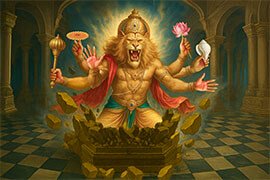
Madhusudana Gaura Chaturdashi is celebrated as Narasimha Chaturdashi by ISKCON and Vaishnava devotees. This day is celebrated as Narasimha Jayanti by Smarta and other Hindu sects. On this day, Lord Vishnu incarnated as Shri Narasimha to protect Bhakta Prahlada.
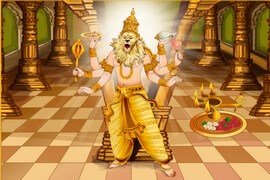
It is a very popular Aarti dedicated to Lord Narasimha, which is sung on special occasions related to Lord Narasimha and in daily worship.
On Narasimha Jayanti day Lord Vishnu appeared in the form of Narasimha, a half lion and half man, to kill Demon Hiranyakashipu. ISKCON and Vaishnava devotees celebrate this date as Narasimha Chaturdashi with great joy and observe a one-day fast to please Lord Narasimha.
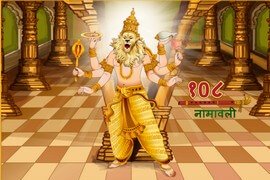
Mantra and Names of Lord Narasimha with meaning are given on this page.
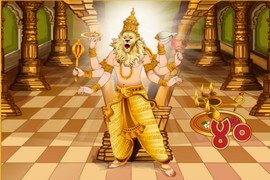
This is a very popular Chalisa dedicated to Lord Narasimha. Devotees of Lord Narasimha recite this Chalisa regularly.
This is a popular Aarti dedicated to Lord Narasimha, known as Narasimha Kunwar Aarti. This Aarti is sung during the worship of Lord Narasimha.
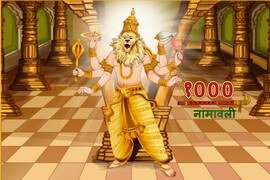
Mantra and Names of Shri Lakshminarasimha, also known as Sahasranamavali of Shri Lakshminarasimha are given on this page.
Shri Narasimha Ashtottarashatanama Stotram dedicated to Lord Narasimha, is given with lyrics and video. This Stotram should be recited to please Lord Narasimha.
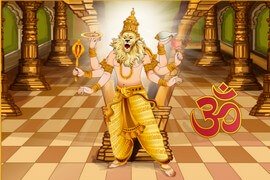
Shri Lakshminarasimha Stotram dedicated to Lord Lakshminarasimha is given with lyrics and video. This Stotram is very fruitful. Shri Lakshminarasimha is one of the forms of Lord Narasimha.
Shri Narasimha Gayatri Mantra is provided with meaning and video. Apart from the Moola Gayatri Mantra, Gayatri Mantras dedicated to various Gods and Goddesses are also described in religious scriptures.
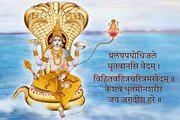
The given Shri Vishnu Dashavatara Stotram is a very melodious and effective Stotram dedicated to the ten incarnations of Lord Vishnu.
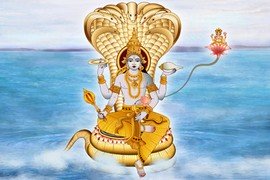
Lord Vishnu is the protector of the entire universe and one of the Trimurti. It is believed that, this visible world is the dream of Lord Vishnu sleeping in Kshirsagar. On this page you can get many information related to Lord Vishnu.
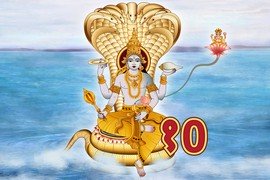
The list of the ten major incarnations of Lord Vishnu and the dates of their birth anniversaries are given on this page. From this page you can also get interesting information about all the incarnations.
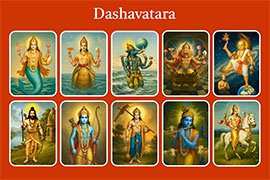
Lord Vishnu keeps taking various incarnations forms from for the welfare of the universe. Here is the ten main incarnations of Lord Vishnu have been described in the religious scriptures as Dashavatara. According to religious scriptures, Kalki incarnation, one of the Dashavatars, is going to appear at the end of the present Kaliyuga.
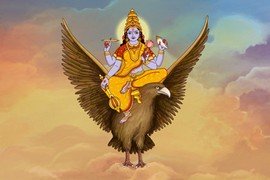
A complete list of Ekadashi dates is given here. Go through the Ekadashi fasting dates list here so that you never miss fasting on Ekadashi. Ekadashi fast is observed with great enthusiasm by the devotees of Lord Vishnu.
ISKCON devotees can get the complete list of ISKCON Ekadashi fasting dates here. This list will prove highly informative and useful to those who observe the fast of Ekadashi as per the ISKCON.
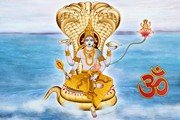
The list of Mantras used in the worship and chanting of Lord Vishnu is available on this page. Some of these Mantras are legendary and some are Vedic. Along with this, the powerful Yantra of Lord Vishnu can also be seen from this page.