



En



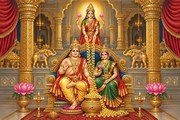
Lord Indra is one of the most popular deities described in Hindu scriptures. He is depicted as the God of Rain. Being the king of the Gods, He is known as Devaraja Indra. Based on various mythological references, Vedic scholars believe that Indra is not a specific individual but the name of a Pada, i.e., designation, which represents the highest position in the heavenly realm, i.e., Swarga Loka. In the Eighth Skandha of Devi Bhagavata, Indra is described as one of the Ashta-Dikpalas and His capital city is known as Amaravati.
With the change of each Manvantara, a new Indra is appointed. Every Manvantara has its own Indra and in the present Manvantara, the ruler of Swarga Loka is Indra named Purandara.
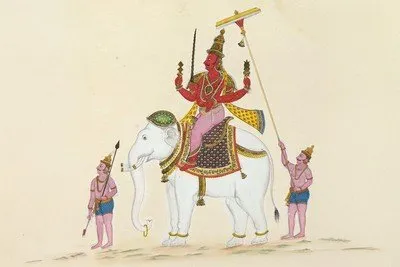
Devaraja Indra rules over heaven. His throne is called the Indrasana and his royal court is known as the Indra Sabha. Indra occupies a position of great importance in the Vedas. The most extensive descriptions of Indra are found in the Rigveda, where about 250 hymns and more than 50 Mantras are dedicated to Him.
Indra is generally described as a title rather than a single personality. According to belief, one who performs 100 Ashvamedha Yajnas attains the position of Indra.
Various accounts of Indra's origin are found in the scriptures. In one place, Indra is described as having emerged from Soma. According to the description found in the 18th hymn of the Fourth Mandala of the Rigveda, Indra was born from the womb of Devmata Aditi. At the time of his birth, a demoness named Kushava attempted to kill Him, but Indra slew her.
Indra is extremely fond of Soma Rasa and is described as consuming it in great quantity. Soma Rasa grants Him strength and vitality. During His battle with the demon Vritra, Indra drank the Soma Rasa from three Sarovara, i.e., entire reservoirs filled with it. In the 119th hymn of the Tenth Mandala of the Rigveda, Indra is shown glorifying His heroic deeds, strength and valor after consuming Soma Rasa. Indra is also regarded as the protector of Soma.
Indra defeated many demons, including Vritrasura, Namuchi, Ahi, Rohina, Shambara, Urana, Vishvarupa, Arbuda, Bala and Vyansha. In the Vedas, Indra is portrayed as a benefactor, protector and friend of His devotees. In the Puranic pantheon, Indra is the king of the Gods, i.e., Devendra. He resides in Amaravati, the capital of the celestial realm, where the divine Nandana Garden, adorned with Kalpavriksha, Parijata flowers, Hari Chandana and Mandara trees, is situated. His royal court is called Sudharma and his council consists of a thousand ministers. His consort is Shachi, also known as Indrani. His vehicle is Airavata; the celestial elephant obtained during the churning of the ocean. His divine horse is Uchchaihshrava. Indra wields celestial weapons such as the Vajra and Ashani.
According to various mythological narratives, whenever any being performs severe penance aspiring to attain the throne or position of Indra, Indra becomes concerned about the safety of His throne. To protect His position, He sends Apsaras, i.e., celestial nymphs to distract Yogis, sages and ascetics from their penance. Numerous accounts attest to this belief. In one such incident, Lord Shiva rendered Indra unconscious and imprisoned Him in a cave along with four former Indras. In another story, Lord Vishnu slew the demon Narakasura, who desired the position of Indra. It is also mentioned that under the leadership of Shakra, sages and Gods requested Lord Skanda to become the Indra of the Gods. However, due to the sin of Brahma Hatya, Shakra had to relinquish the position of Indra, after which Nahusha became Indra. Later, when Nahusha fell from grace, Shakra regained the Indra throne by performing the Ashvamedha Yajna as instructed by Lord Vishnu. The Mahabharata also contains several examples confirming that Indra is not a single individual but a position.
In Shri Vishnu Purana, Third Part, Chapters 1 & 2 and the Bhagavata Mahapurana Eighth Skandha, Chapters 1 & 13, the names of different Indras ruling over the fourteen Manvantaras are listed. According to Vedic chronology, Indra also represents a period of time, i.e., Kala. The fourteen Indras of the fourteen Manvantaras are Yajna, Vipashchit, Sushanti, Shibi, Vidhu, Manojava, Purandara, Bali, Adbhuta, Shanti, Visha, Ritudhama, Devaspati and Suchi. At present, Purandara, one of the twelve sons of Maharshi Kashyapa and Aditi, rules Swarga Loka.
According to a reference in the Rigveda, Indra is described as "Harishmashru", meaning one with green beard and moustache. A related account in the Mahabharata states that due to a curse by Sage Gautama, Indra's beard and moustache turned green. This is why He became known as Harishmashru.
In Vedic texts, Indra is described as a colossal deity. His vast body is said to extend to more than ten times the size of the Earth. He is often depicted with green beard and moustache. In many depictions, due to a curse, Indra is also shown with thousands of eyes spread across His entire body.
According to scriptures, Nishthigri or Shavasi, a cow, is described as Indra's mother, while Dyauh or Tvashta is mentioned as His father. Agni and Pushan are His brothers. His wife is Shachi, also known as Indrani. Indra's son is named Jayanta.
Moola Mantra -
ॐ इन्द्राय नमः।
Om Indraya Namah।
Indra Gayatri Mantra -
ॐ सहस्रनेत्राय विद्महे वज्रहस्ताय धीमहि।
तन्नो इन्द्रः प्रचोदयात्॥
Om Sahasranetraya Vidmahe Vajrahastaya Dhimahi।
Tanno Indrah Prachodayat॥

Sahasranamavali of Lord Indra is given with the above Mantras. These Mantras are chanted to seek the blessings of Lord Indra.
Indra Dev Gayatri Mantra is given with Sanskrit lyrics and recitation video. Devotees chant Indra Gayatri Mantra to please Lord Indra. Indra Deva is one of the main deities worshipped in Hinduism and is called the king of Gods.