



En




Notes: All timings are represented in 12-hour notation in local time of Lancaster, United States with DST adjustment (if applicable).
Hours which are past midnight are suffixed with next day date. In Panchang day starts and ends with sunrise.
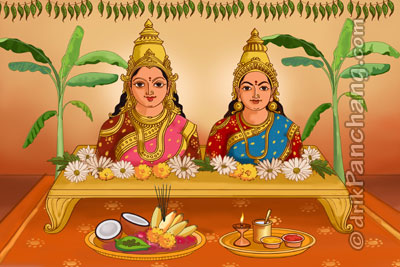
Jyeshtha Gauri Puja is a traditional Maharashtrian festival celebrated mostly among the people of Marathi community. It is a revered Hindu ritual observed especially in Maharashtra and nearby regions, during the festive period of Ganesha Chaturthi. The celebration is centered around the welcoming and installation of Goddess Gauri and is observed on the Shukla Paksha Ashtami Tithi of Bhadrapada month. This festival symbolizes the arrival of Goddess Gauri from Her maternal home to Her in-laws' house, reflecting deep-rooted familial and cultural sentiments.
The invocation of Jyeshtha Gauri is considered a family tradition, passed down through generations. In Maharashtra, it is believed that after the arrival of Lord Ganesha, Goddess Gauri visits the household, a tradition known as Gauri Avahan. This usually takes place on the Third, Fourth or Fifth day after Ganesha Chaturthi. The day following Her arrival is dedicated to Gauri Puja and the day after that marks Gauri Visarjan. In some families, two idols of Gauri are brought home, representing Jyeshtha Gauri or Maherchya Gauri, meaning Gauri from the maternal home.
In this tradition, idols of Goddess Gauri made from metal, clay, stone or wood are brought into the home with great devotion and purity. Prior to bringing the idols, special preparations are made which include cleaning the Puja area, creating Rangoli, setting up festive Torans and installing Mangala Kalash. As the deity is welcomed, women sing traditional folk songs and invite the Goddess into the home with love and reverence.
Upon the arrival of Goddess Gauri, She is offered Solaha Shringara, the sixteen traditional adornments of a married woman. These include Saree, Chunari, comb, bangles, Bindi, Kajal, perfume, garments, necklaces and bracelets, along with various other ornaments. Depending on one's capacity, gold jewelry and silk garments are also offered to the Goddess. Additionally, betel leaves and areca nuts, turmeric, vermilion, coconuts and other traditional offerings are presented. It is believed that a woman who invokes Jyeshtha Gauri with devotion is blessed with marital happiness, peace and progeny. The arrival of Goddess Gauri in the home is considered a symbol of divine energy, auspiciousness and beauty.
During this Avahan, Gauri Puja is performed and the deity is kept enshrined in the home for one or two days, depending on family tradition. During this time, the household remains immersed in a sanctified and festive atmosphere. Women pray to the Goddess for prosperity, wealth, well-being and good fortune. Traditional Maharashtrian delicacies such as Puran Poli, Laddu, Chawli Bhaji, Varan-Bhaat, etc. are offered as Naivedya.
After Gauri Pujan, Gauri Visarjan is performed on the designated day. Before the Visarjan, the Goddess is again worshipped, offered aarti and traditional farewell songs are sung. The Visarjan is primarily performed by women and the farewell is done in the spirit of sending a beloved daughter back to Her marital home. Thus, Jyeshtha Gauri Avahan is not merely a religious ritual, but a deeply rooted cultural tradition, driven by devotion to the Goddess, the celebration of womanhood, motherhood and family welfare. It holds equal importance in scriptural tradition as well as local folklore, embodying a unique blend of faith and cultural heritage.
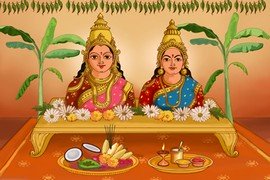
The very popular Jyeshtha Gauri Vrat Katha is described here. This story is based on a poor Brahmin who didn't even have enough money to invoke Goddess Gauri in his house. Saddened by this, the Brahmin was about to end his life when Goddess Gauri appeared before him as an old woman.
In Maharashtra, the festival of Jyeshtha Gauri Puja is celebrated with great joy and enthusiasm. On this day, Goddess Parvati is worshipped in the form of Jyeshtha Gauri, and Goddess Mahalakshmi is worshipped as Kanishtha Gauri. On the following day, the Jyeshtha Gauri Visarjana is performed.
This marks the final day of the three-day Jyeshtha Gauri Puja festival. On this day, the farewell Visarjana of Goddess Gauri is performed. Before the Visarjana, a grand and elaborate procession is organized, in which all the local residents take part.