



En



Notes: All timings are represented in 12-hour notation in local time of Lancaster, United States with DST adjustment (if applicable).
Hours which are past midnight are suffixed with next day date. In Panchang day starts and ends with sunrise.
Jyeshtha Gauri Visarjan is an important religious ritual observed in Maharashtra. This festival is primarily celebrated by the Marathi community. Jyeshtha Gauri Visarjan marks the final day of the three-day Jyeshtha Gauri Puja festival. The three-day observance includes Gauri Avahan on the first day, Gauri Puja on the second day, and Gauri Visarjan on the third day. Here, Visarjan does not signify immersion of the idol in water but rather symbolizes the ceremonial farewell of the Goddess after Her visit from Her maternal home.
Just as the arrival and Visarjan of Lord Ganapati are celebrated with great enthusiasm in Maharashtra, worship and farewell of Goddess Gauri are also conducted with deep devotion and reverence. Goddess Gauri is regarded as the presiding deity of power, marital bliss and peace.
According to religious scriptures such as the Skanda Purana and Devi Bhagavata Purana, performing Gauri Vrat and Puja bestows blessings of fortune, progeny and prosperity. Ritual texts like Vrataraja and Kalpadruma Tantra also describe the procedures and significance of Gauri Puja and Visarjan in detail.
On the day of Jyeshtha Gauri Visarjan, the observing women begin their day with a ritual bath and then adorn the Goddess Gauri once again with ornaments and worshiped. Devotees offer fruits, flowers, Naivedya, and Solah Shringar, i.e., sixteen types of traditional adornments to Goddess. The women of the household perform the Aarti and sing Mangala Geet. After the worship, a prayer is offered to the Goddess, requesting Her to return the following year and to bless the family with fortune, health and prosperity.
Following this, Gauri Mata is seated in a Palaki, i.e., palanquin and a grand procession is carried out, in which nearly all members of the Koli community participate. Devotees perform Aarti outside their homes as the procession passes. Women sing traditional songs such as "Gauri Aali Ghara, Laadu De Bara" during the farewell. On this occasion, the Goddess bid farewell like a beloved daughter or sister. Devotees don't see Gauri merely as a deity but as an inseparable member of their family and worship Her with deep love and reverence.
For Visarjan, Goddess Gauri is placed on a boat and taken out into the sea. Thereafter, as a symbolic immersion, the mask of the Goddess is dipped three times into the sea water. Following this, the presiding Purohit Ji sprinkles sea water on all the people gathered at the shore. The mask of the Goddess is preserved carefully for worship the following year. During the immersion, women pray for the long life of their children and husband with the well-being of the family.
Thus, Jyeshtha Gauri Visarjan is completed. Among the many worship traditions practiced in Hinduism, this is a distinct ritual wherein the deity is invoked, worshipped, farewelled, and invited again for the next year. Hence, Jyeshtha Gauri Visarjan is not just a ritual, but a symbol of deep reverence, devotion and unwavering faith in Goddess Shakti.
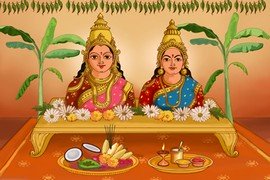
The very popular Jyeshtha Gauri Vrat Katha is described here. This story is based on a poor Brahmin who didn't even have enough money to invoke Goddess Gauri in his house. Saddened by this, the Brahmin was about to end his life when Goddess Gauri appeared before him as an old woman.
Jyeshtha Gauri Avahana is a very popular Hindu festival which is mainly observed in Maharashtra. On this day, Goddess Jyeshtha Gauri is invoked and invited into homes for three days of worship. On the following day, the Jyeshtha Gauri Puja is performed.
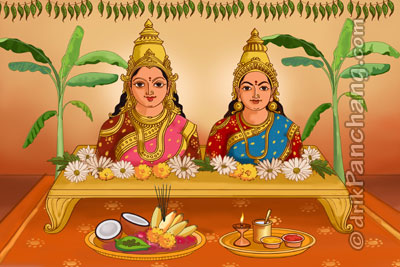
In Maharashtra, the festival of Jyeshtha Gauri Puja is celebrated with great joy and enthusiasm. On this day, Goddess Parvati is worshipped in the form of Jyeshtha Gauri, and Goddess Mahalakshmi is worshipped as Kanishtha Gauri. On the following day, the Jyeshtha Gauri Visarjana is performed.