



En





Notes: All timings are represented in 12-hour notation in local time of Lancaster, United States with DST adjustment (if applicable).
Hours which are past midnight are suffixed with next day date. In Panchang day starts and ends with sunrise.
A day before Diwali Puja, Hanuman Puja is performed in some parts of India especially in Gujarat. The very same day is observed as Shri Hanuman Jayanti at Hanumangarhi (हनुमानगढ़ी) temple in Ayodhya. However most of the people in North India celebrate Hanuman Jayanti on Chaitra Purnima.
The day of Hanuman Puja coincides with the day of Kali Chaudas. It is believed that the bad spirits are most powerful during the night of Kali Chaudas. Lord Hanuman, who gives strength to fight evil spirits, is worshipped to seek strength, power and the protection from all sorts of bad spirits.
According to another legend, Diwali is celebrated to mark the return of Lord Rama to Ayodhya after defeating demon Ravana and completing His fourteen years of exile. The devotion and dedication of Hanuman pleased Shri Rama so much that He blessed Hanuman for getting worshipped before Him. Hence people worship God Hanuman a day before Diwali celebrations.
In this Vrat, the currently prevailing Ratrivyapini Tithi should be observed. If it falls on two days, then the Vrat should be observed on the second day. For observing Hanuman Jayanti Vrat, the observer should, on the night of Dhantrayodashi, remember Lord Rama, Mata Janaki, and Hanuman Ji, and sleep on the ground. Thereafter, on Chaturdashi, one should wake up before Arunoday, again remember Shri Rama-Janaki and Hanuman Ji, and complete the morning ablutions and daily rituals. Then, taking water in hand, one should take the following Sankalpa -
ममाखिलानिष्टनिरसनपूर्वकसकलाभीष्टसिद्धये
तेजोबलबुद्धिविद्याधनधान्यसमृद्ध्यायुरारोग्यादिवृद्धये
च हनुमद्व्रतं तदंगीभूतपूजनं च करिष्ये।
Mamakhilanishtanirasanapurvakasakalabhishtasiddhaye
Tejobalabuddhividyadhanadhanyasamriddhyayurarogyadivriddhaye
Cha Hanumadvratam Tadangibhutapujanam Cha Karishye।
After taking the above Sankalpa, one should sit facing east or north in front of the already established idol of Hanuman Ji and respectfully recite the following prayer -
अतुलितबलधामं स्वर्णशैलाभदेहं दनुजवनकृशानुं ज्ञानिनामग्रगण्यम्।
सकलगुणनिधानं वानराणामधीशं रघुपतिवरदूतं वातजातं नमामि॥
Atulitabaladhamam Svarnashailabhadeham Danujavanakrishanum Jnaninamagraganyam।
Sakalagunanidhanam Vanaranamadhisham Raghupativaradutam Vatajatam Namami॥
Thereafter, one should perform the Shodashopachara Puja of Hanuman Ji. If a river is nearby, then bathe Him with its water; otherwise, bathe Him with well water mixed with sacred water. Adorn Him with a red Kaupina and Pitambara. Apply saffron-mixed sandal paste, offer a Yajnopavita made of Munja grass, and offer flowers such as Shatapatra (Hajara), Ketaki, Kaner, and other yellow-colored flowers. After that, light incense of Agar, Tagar, etc., and a Diya with a wick soaked in cow Ghee. In Naivedya, offer Ghritapakva, that is, Apupa (Pua) prepared in Ghee, or Modaka made by roasting flour in Ghee and mixing it with jaggery, along with fruits such as banana. -
मनोजवं मारुततुल्यवेगं जितेन्द्रियं बुद्धिमतां वरिष्ठम्।
वातात्मजं वानरयूथमुख्यं श्रीरामदूतं शिरसा नमामि॥
Manojavam Marutatulyavegam Jitendriyam Buddhimatam Varishtham।
Vatatmajam Vanarayuthamukhyam Shriramadutam Shirasa Namami॥
After the above prayer, distribute Prasada and, according to one's capacity, organize Brahman Bhoj and then partake of food oneself. At night, remain awake by performing Deepavali, Stotra recitation, singing, musical performances, and Sankirtana. To understand the significance of the Vrat, recite or listen to the Hanuman Jayanti Vrat Katha.
If the Vrat is to be performed for the fulfillment of a specific desire, then on Margashirsha Shukla Trayodashi, after completing morning rituals, prepare a Vedi and make 13 lotus shapes using Akshata-Punja. Install a water-filled, worshipped Kalasha upon them. On top of it, place a yellow cloth, and upon the 13 lotus shapes, place a Pita Sutra, that is, yellow thread of nine strands with 13 knots, that is, a yellow sacred thread. Thereafter, worship the Vedi and perform the Puja, Japa, Dhyana, and Upasana of Hanuman Ji according to the above procedures or prescribed procedure. After feeding Brahmanas, complete the Vrat by taking food.
In this manner, by observing the Hanuman Jayanti Vrat with devotion, all desired wishes of the observer are fulfilled, and all kinds of known and unknown difficulties are removed.
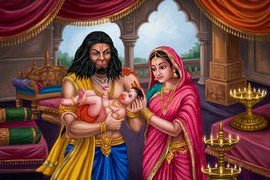
The story of the birth of Lord Hanuman is described. This story is recited and listened to on the occasion of Hanuman Jayanti. Lord Hanuman is one of the most revered and popular deities in Hinduism. He is also known as the greatest devotee of Lord Rama.
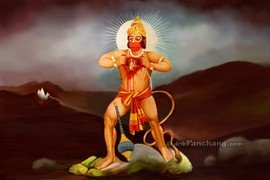
In this article, a detailed description has been given about Lord Hanuman. Lord Hanuman is one of the most popular deities worshipped in Hinduism. Hanuman Ji is also known by the names Mahavira, Bajrangbali, Anjaneya and Pavanputra etc.
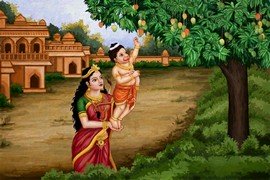
Hanuman Jayanti is celebrated to commemorate the birth of Lord Hanuman on the full moon day of Chaitra month. Hanuman Jayanti is also known as Hanumath Jayanti and Hanuman Vratam.
This is one of the most popular Aartis dedicated to Lord Hanuman which is recited on various occasions related to Lord Hanuman. This Aarti is also sung during Dainika Hanuman Puja.
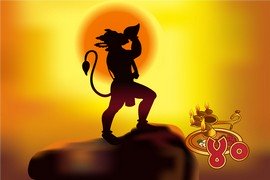
This 40 verse poem praising Lord Hanuman is known as Hanuman Chalisa. Hanuman Chalisa is the most popular hymn dedicated to Lord Hanuman, which is sung everyday by Hanuman devotees.
List of Hanuman Mantras including Hanuman Moola Mantra, Hanuman Gayatri Mantra and Manojavam Marutatulyavegam Mantra are given on this page. These Mantras are chanted to please Lord Hanuman and seek His blessings.
Mantra Names of Lord Hanuman with meaning and video are given on this page.
Hanuman Jayanti is celebrated to commemorate the birth of Hanuman, the Vanara god, widely venerated throughout India. The Date and Time of Hanuman Jayanti is given in this article.
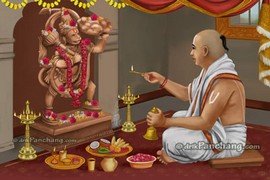
People worship Lord Hanuman by Shodashopachar Hanuman Puja Vidhi to please Him and seek His blessings. This Puja Vidhi includes sixteen steps of worship like Sankalpa, Aawahana, Dhyana, Asana, Paadya, Arghya etc.
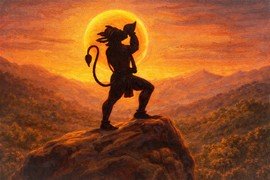
Hanumath Jayanthi is observed during Margashirsha Amavasya and falls in January or December. Hanuman Jayanti is celebrated as Hanumath Jayanti in Tamil Nadu. It is believed, Lord Hanuman was born on this day during Moola Nakshatra.
Telugu Hanuman Jayanthi is slightly different from other Hanuman Jayanti. In Andhra Pradesh and Telangana, Hanuman Jayanti is celebrated for 41 days starting from Chaitra Purnima. Telugu Hanuman Jayanti Muhurat and Deeksha Muhurat day is given on this page.
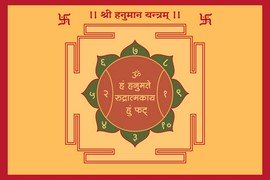
Full size Shri Hanuman Yantra wallpaper is provided here for Hanuman Puja. The above image can be printed and used for Puja. In Hinduism, the consecrated Yantra is worshipped as the manifestation of the related deity.
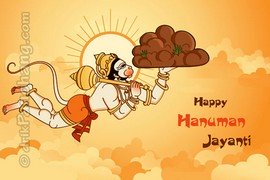
You can send Hanuman Jayanti wishes to your loved ones through these Hanuman Jayanti E-Greetings. In the pictures given in these E-Cards, Lord Hanuman is shown Flying with Mountain, Giving Blessings and Sitting on the Seat of His Tail, and many more...