



En



King Dasharatha said to his Guru Vashistha - "O Sage! I am still not satisfied even after drinking the nectar of these sacred stories. Therefore, kindly describe the significance of Phalguna Shukla Paksha Chaturthi."
Sage Vashistha said - "O best among kings! The Chaturthi of the Shukla Paksha in the month of Phalguna is bestower of boons. I shall now narrate the significance associated with this Vrat; listen attentively -
In the Malava Pradesh, there existed a magnificent city named Bharaka, adorned with every kind of prosperity and splendour. The city was inhabited by righteous and virtuous people. There ruled a pious king named Hemangada, who governed his kingdom with justice and righteousness. King Hemangada was not only skilled in warfare and weaponry but was also highly knowledgeable and learned. He had conquered the entire earth; therefore, he was respected and acknowledged by all kings. He was also dear to Brahmins, Deities, and guests.
In due course of time, one day suddenly, King Hemangada was afflicted with a severe disease known as Udara Shula, i.e., abdominal colic. He began to suffer unbearable pain in his stomach, as if struck by a weapon. Unable to bear the intense agony, the king began to cry. Various Mantras and medicines were used to cure him, but instead of relief, his pain only increased. Thereafter, as advised by learned scholars, the king visited sacred pilgrimage places and worshipped various Deities, but his suffering continued to grow. The pain became so unbearable that the king decided to renounce his life.
At that very moment, by divine coincidence, the great Yogi Parvata Muni arrived at the king's palace. The afflicted king respectfully bowed to the sage and requested relief from his suffering. King Hemangada said - 'O great sage! By the sight of your sacred lotus feet, my life has become blessed, and my parents and descendants are also sanctified.' Saying this, the king collapsed on the ground due to pain and began to cry. Seeing the king's condition, the Brahmins present there were astonished. Observing their surprise, Parvata Muni asked the king's ministers - 'O ministers! How has King Hemangada come to suffer such terrible pain? Tell me the cause of his misery.'
The ministers replied - 'O revered sage! Our king has been suffering from severe abdominal pain. Many remedies, Mantras, and medicines have been tried. He has even visited numerous pilgrimage places and worshipped various Deities, but he has not been relieved. Instead, his pain has only increased.'
Hearing this, Parvata Muni entered into deep meditation and, perceiving the king's sin, said - 'O King! A grave sin has occurred in your kingdom, due to which you are suffering from this pain. The observance of Ganesh Chaturthi Vrat has completely ceased in your kingdom. Because of this collective fault, you, though righteous, have been afflicted with this suffering.'
The king folded his hands and said - 'O noble sage! What kind of Vrat is this? Whom does it worship? Who first established this Vrat in ancient times? Kindly satisfy my curiosity.'
Parvata Muni said - 'O King! By observing this Ganeshwara Vrat, success is attained in all endeavors, and the four Purushartha, that is, Dharma, Artha, Kama, and Moksha are achieved. This Vrat is revered throughout the world.' Saying this, the sage described the greatness of Chaturthi in detail. After listening, the king was greatly pleased and said - 'O great sage! What is the nature and form of Lord Ganesha? Kindly describe His form so that I may meditate upon Him.'
Parvata Muni said - 'O King! I shall now narrate a sacred account related to Lord Ganesha which I heard in ancient times. Listen carefully. Once, I was performing intense penance with full dedication to Dharma. Due to my austerities, the entire earth became heated. Seeing this, Indra, the king of the Devas, became disturbed and sent Kamadeva along with Apsara, i.e., celestial nymphs to disturb my penance. However, due to the power of my austerity, even Kamadeva began to burn, and Indra fled from there with him. Thereafter, I became absorbed in deep meditation and self-control by following Shama and Dama. After some time, by divine fortune, the great Yogi Nidagha Rishi, the knower of the Avadhuta path, appeared before me. I bowed to him with reverence and worshipped him, and said - 'O great Yogi! By the sight of your divine feet, I am blessed. Kindly grant me the knowledge of that Yoga which bestows peace, so that I may become worthy of reverence among Yogis.''"
Then Vashistha Muni said to King Dasharatha - "O King! When Parvata Muni asked this question, the great ascetic Nidagha said - 'O Parvata! I shall narrate an ancient account by which I became revered even among great Yogis. Listen carefully. In ancient times, I practiced great Yoga and attained a state of Svananda, i.e., inner bliss, remaining established in the joy of the Self. I experienced a form of bliss that existed amidst dualities, which brought me peace. Thereafter, I approached Lord Vishnu, as although I had attained peace, it still appeared dual in nature, which caused confusion. I said - 'O Lord! Kindly grant me the knowledge of that Yoga which gives true peace.'
The great Yogi Lord Vishnu said - 'O Dear! You should know Lord Ganesha, who bestows Yoga Shanti. By knowing Him, all Yogis attain peace. In His name Gana, the syllable Ga, i.e., Gakara represents that which is associated with mind and speech, while Nakara represents that which is beyond mind and speech. Thus, He is both knowable and unknowable. He is the Lord of all groups, i.e., Ganas, hence called Ganesha. Worship Him properly, and you will surely attain peace.'
Saying this, Lord Vishnu became silent. I bowed to Him and went into the forest, where I engaged in Yoga and worshipped Lord Ganesha with Ekakshara Mantra, i.e., a one-syllable Mantra. After ten years of continuous practice, Lord Ganesha became pleased and appeared before me. Seeing me absorbed in meditation, He said - 'O child! I am pleased with your devotion. Ask for any boon you desire.'
I bowed to Lord Ganesha, worshipped Him, and praised Him with hymns from the Samaveda. Pleased by my praise, He granted me peace and disappeared. From that moment onward, I became Ganapatya, i.e., a devotee of Ganesha and remained constantly absorbed in His meditation. Therefore, you too should worship Lord Ganesha, the bestower of supreme peace.' Saying this, Nidagha Muni gave Parvata Muni the sacred Mahamanu Mantra and explained the method of recitation for that Ekakshara Mantra and then disappeared.
Parvata Muni said - 'O King! Since that time, I have been continuously worshipping Lord Ganesha with devotion. By chanting His Mantra, I attained peace, and He granted me the vision of His divine Yogic form.' Saying this, Parvata Muni gave King Hemangada the ten-syllable Mantra, that is, Gam Ganapataye Namo Namah। and disappeared."
Vashistha Muni said - "O King Dasharatha! After receiving the Mantra, King Hemangada first observed the sacred Vrat of Phalguna Shukla Chaturthi. He proclaimed throughout his kingdom that all people must observe the Chaturthi Vrat of both Shukla Paksha and Krishna Paksha every month. By the merit of this Vrat, the king's abdominal pain was cured, and all other people also became free from diseases. People became prosperous with wealth, grains, and progeny. In due course of time, King Hemangada became deeply devoted to Lord Ganesha and, after handing over the kingdom to his son, attained supreme peace along with his wife and merged into Brahman. Thereafter, other people too gradually attained divine bliss through the glory of this Vrat."
Vashistha Ji continued - "O best among kings Dasharatha! Now listen to another account related to Phalguna Shukla Chaturthi. In ancient times, in the city of Bharaka, there lived a Brahmin who had abandoned his Dharma. From childhood, he engaged in violence, theft, and causing suffering to others. As he grew older, he committed heinous crimes such as murder and criminal assault. He was immoral and killed animals for food. He even killed humans and Brahmins for wealth.
One day, while wandering in the forest, he saw a merchant approaching. With the intention to kill, the sinful Brahmin ran towards him. Seeing him, the merchant's son fled and cried out loudly for help. Hearing his cries, four travelers passing by came to his aid. They captured the Brahmin and handed him over to the soldiers. The soldiers beat him severely and presented him before the royal court. The king ordered that he be punished harshly. The soldiers brutally beat him and threw him into a pit.
During that time, Phalguna Shukla Chaturthi arrived, and the Brahmin remained there without food. Due to hunger and the torment inflicted by the soldiers, he died on the following day, Panchami Tithi. After his death, the attendants of Lord Ganesha appeared to take him.
O King Dasharatha! The attendants of Lord Ganesha took him to Svanandapura, where, upon seeing Lord Ganesha, even that sinful Brahmin became Brahmabhuta, i.e., liberated. Thus, by the power of the Chaturthi Vrat, many people attained liberation. It is not possible to describe the greatness of all such instances. Therefore, whoever listens to or recites the glory of Phalguna Chaturthi, Lord Ganesha, the remover of obstacles, fulfills all their desires."
॥Thus concludes the Phalguna Shukla Paksha Chaturthi Mahatmya as described in Mudgala Purana।
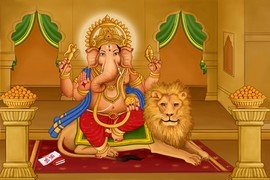
According to the Hindu calendar, Shukla Paksha Chaturthi of Phalguna month is observed as Dhundhiraja Vinayaka Chaturthi. On this day, Lord Ganesha is worshipped in the form of Lord Dhundhiraja. Dhundhiraja Vinayaka Chaturthi is also known as Dhundhiraja Chaturthi.
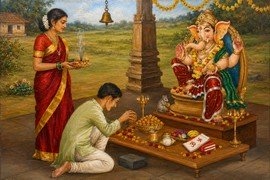
The complete detailed Shodashopachara Puja Vidhi of Lord Ganesha is described including Dhyanam, Avahanam, Pushpanjalih and Swagatam Mantras. In the given Puja Vidhi, audios of Mantras are also given so that one can learn the correct pronunciation.
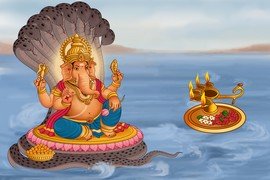
Most popular Aarti dedicated to Lord Ganesha is given with lyrics and recitation video. Devotees sing this Aarti to please Lord Ganesha and seek his blessings.
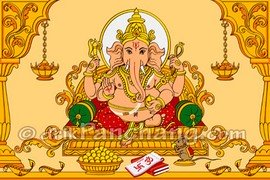
In the Hindu calendar, there are two Chaturthi in every lunar month. The Chaturthi of Shukla Paksha that comes after Amavasya is called Ganesha Chaturthi. In Kerala, Ganesha Chaturthi is celebrated in Chingam Masam during Shukla Paksha Chaturthi and might fall in Shravana month.
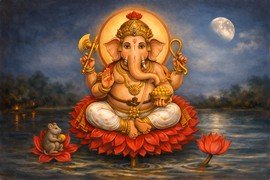
In the Hindu calendar, there are two Chaturthi in every lunar month, out of which the Chaturthi of Krishna Paksha that comes after the full moon is called Sankashti Chaturthi. The fast of Sankashti Chaturthi is more popular in western and southern region of India, especially in Maharashtra and Tamil Nadu.
This is a very melodious and popular Aarti dedicated to the Vinayaka form of Lord Ganesha. This Aarti is sung on various occasions related to Lord Ganesha.
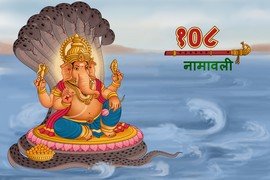
Ashtottara Shatanamavali of Ganesha is a collection of 108 divine names of Lord Ganesha. One can recite these names to seek the blessings of Lord Ganesha.
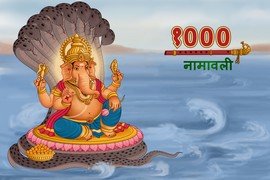
Sahasranamavali of Lord Ganesha containing these Mantras and names is given with meaning and recitation video.
Gakara Sahasranamavali of Ganesha containing these Mantras and names is given. In this Namavali, all the names of Lord Ganesha start with the letter "G"
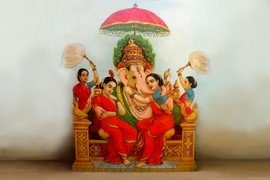
Lord Ganesha is one of the most popular deities in Hindu Dharma. He is revered as Pratham Pujya i.e. He is worshipped first among all the deities. He is worshipped to remove all kinds of obstacles.
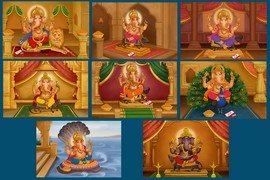
The divine eight incarnations of Lord Ganesha are collectively known as Ashta Vinayaka. Vakratunda, Ekadanta, Mahodara and Gajanana are some popular forms of Ashta Vinayaka.
Ganesha Anga Puja is usually performed on Ganesha Chaturthi and other festivals related to the Lord Ganesha. Each vital body part of God Ganesha is worshipped with Mantras in Anga Puja.
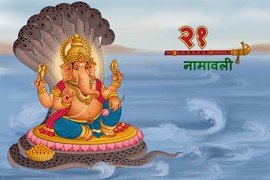
Ganesha Twenty One Names Puja is also known as Eka-Vimshati Name Puja which is dedicated to the Lord Ganesha who is lord of knowledge and wisdom.
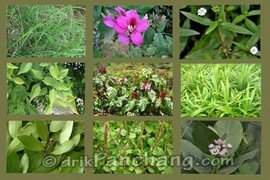
List of 21 Patra for Ganesha Chaturthi Puja is given here. There are 21 types of Patras i.e. leaves which are used for worshipping Lord Ganesha on special occasions.
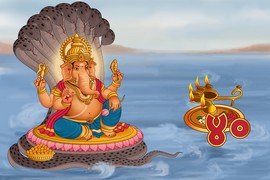
'Ganesha Chalisa' is a hymn composed of 40 Chaupais in the praise of Lord Ganesha. One can get rid of all the obstacles by reciting Ganesha Chalisa.
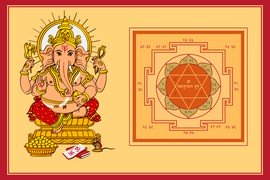
Some of the most important Ganesha Mantras are listed here. A powerful Ganesha Yantra is also given which one can keep at one's home or office at the place of worship.
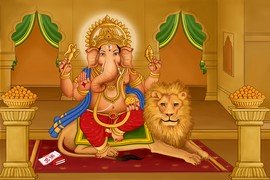
'Vakratunda Mahakaya' Mantra is one of the most significant and popular Mantras of Lord Ganesha. Lord Ganesha gets easily pleased by chanting this Mantra.
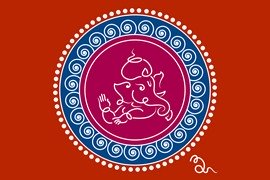
Simple and beautiful Ganesha Rangoli designs are given on this page. These Rangoli can be used on various special occasions related to Lord Ganesha.
Here you can send E-cards of Lord Ganesha to your loved ones. There are so many beautiful and artistic E-cards which are available on this page.