


En


Once, on Mount Sumeru, the Gods requested Lord Brahma, who was seated there, to describe Avinashi Tatva, i.e., the imperishable Supreme Truth. Deluded by the Maya of Lord Shiva, Brahma Ji, despite not truly knowing that Supreme Truth, began to say - "I alone am the self-existent, the creator of this universe, the Supreme Lord, unborn and the Parabrahman. I am the basis of both Pravritti and Nivritti, and I alone am the Supreme Reality." Upon hearing Brahma speak thus, Lord Vishnu, who was present there, explained to him - "O Brahma! It is by My command that you have become the creator for the purpose of creation. Then why are you insulting Me by merely praising your own supremacy?"
Thus, a dispute arose between Lord Vishnu and Lord Brahma to establish their own supremacy. Both began to cite Vedic statements in support of their claims to prove themselves superior. At that very moment, the four Vedas appeared there in embodied form.
First, the Rigveda said - "He within whom all beings reside, from whom the entire moving and unmoving universe proceeds, and who is called the Supreme Self, He alone is Rudra." Thereafter, the Yajurveda said - "He by whom even the Vedas are validated, who is remembered through all Yajnas and Yogas, He is the all-seeing Lord Shiva." The Samaveda said - "He who causes all worldly beings to forget, whom the Yogis seek, and by whose radiance the entire universe is illumined, He alone is Tryambaka Shiva." The Atharvaveda said - "He whose realization is attained through devotion, who is beyond all forms of pleasure and pain, who is the manifest Brahman, He alone is Lord Shankara."
Hearing these words of the Vedas, Lord Vishnu and Lord Brahma said - "O Vedas! This is merely your ignorance. How can you call Shiva the Supreme Reality? He roams freely, remains unclad, rides a bull, is detached, and is covered with ash and dust." Hearing this dispute between Brahma and Vishnu, the divine Omkara Jyoti said - "Lord Shiva alone is the eternal and Sanatana Parabrahman. He is the performer of divine Leela and thus enacts various Leela. Yet, without doubt, He alone is the Supreme Self." However, deluded by Shiva's Maya, the intellect of Brahma and Vishnu did not change.
At that very moment, an eternal and infinite column of light manifested between them. Due to the brilliance of that light, Brahma's fifth head began to burn. At the same time, the trident-bearing, blue-red-hued Lord Shiva appeared there. Out of ignorance, Brahma even began asking Him to take refuge in him.
Hearing the disrespectful words of Brahma, Lord Shiva became furious. From His intense wrath, a being named Bhairava emerged. Lord Shiva said to Bhairava - "O Bhairava! You will control Brahma and uphold the order of the universe. You are like Time itself, therefore you shall be worshipped as Kala Bhairava. O Lord of Time! The city of Kashi, which grants liberation, is the greatest among all cities. I appoint you as its ruler forever. All sinners in that city will be accounted for by you."
Obeying Lord Shiva's command, Bhairava severed Brahma's fifth head with the tip of the nail of his left finger. Brahma became terrified and, reciting the Shatarudriya, took refuge in Lord Shiva. Both Brahma and Vishnu realized the Truth and began praising Lord Shiva. Seeing this, Shiva's anger subsided, and He granted fearlessness to both the Gods.
Because of his terrifying form, Bhairava came to be known as Kala Bhairava, the one who can even terrify Kala, i.e. Death itself. And because he destroys the sins of devotees instantly, he became renowned in all the worlds as Papa Bhakshaka. As declared by Lord Shiva, he became the ruler of Kashi.
Thereafter, Lord Shiva said - "O Bhairava! Showing respect to Brahma and Vishnu, carry Brahma's skull and, sustaining yourself through alms with it, proceed to Varanasi. There, by the influence of that sacred city, you will be freed from the sin of Brahmahatya."
Following Shiva's command, as soon as Bhairava set out towards Kashi carrying the skull in his hand, the sin of Brahmahatya began following him. Lord Vishnu sought a boon from Brahmahatya that He may not be deluded by her Maya. When Vishnu asked her why she was following Bhairava, she replied - "I am following Lord Bhairava for my own purification and liberation."
As soon as Bhairava reached Kashi, Chimta and Kapala, that is, the tongs and the skull fell from his hand onto the ground. From that time, that place became famous as Kapalamochana Tirtha. According to the scriptures, by performing Pind Dana and Deva-Pitru Tarpana there with proper rituals, a person becomes freed from the sin of Brahmahatya. Thus, Lord Shiva manifested Bhairava for the welfare of the universe. This Katha of Bhairava is recited on the day of Bhairava Ravivara Vrat.
॥Iti Shri Bhairava Ravivara Vrat Katha Sampurnah॥
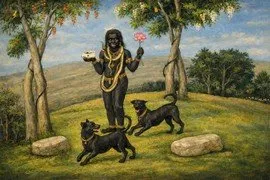
Bhairava Ravivara Vrat is described here. Apart from the introduction of the fast, the method of worship, the method of Udyapana and food considerations for the fast are also described. In Hinduism, Sunday is considered the best day for worshiping and fasting for Lord Bhairava.
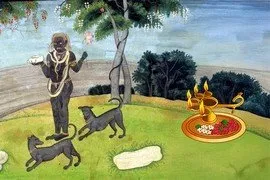
The Shri Bhairava Aarti, dedicated to Lord Bhairava, is given with Hindi lyrics. This Aarti is sung during the worship of Lord Bhairava.
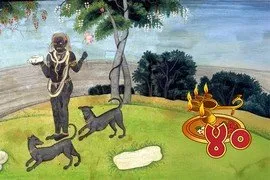
Bhairava Chalisa, dedicated to Lord Bhairava, is given with Hindi lyrics and recitation video. It is recited every Sunday.
Sahasranamavali of Lord Kalabhairava with these names and Mantras is given on this page.
The very popular Batuka Bhairava Aarti is provided with Hindi lyrics and recitation video. This Aarti is sung during the worship of Shri Batuka Bhairava.
Shri Batuka Bhairava Chalisa, dedicated to Lord Batuka Bhairava, is provided with Hindi lyrics and recitation video. This hymn contains 40 verses.
The Ashtottara Shatanamavali of Lord Bhairava, including the above Mantras, is given. These Mantras are chanted during the Bhairava Sadhana.
The Sahasranamavali of Lord Batuka Bhairava, with the above Mantras, is provided. These Mantras are chanted to receive the blessings of Bhairava Ji.
The Batuka Bhairava Ashtottarashatanama Stotram, dedicated to Lord Batuka Bhairava, is given with Sanskrit lyrics and recitation video.