



En




Bhairava Ravivara Vrat is a highly powerful fast dedicated to Lord Kalabhairava. This Vrat is observed on Ravivara, i.e., Sunday. In Hinduism, Ravivara is dedicated to Lord Bhairava. According to the Navagraha, this day is governed by Surya Deva. As described in the scriptures, Bhairava is a Rudra Avatara of Lord Shiva. Bhairava Deva is described as the deity of justice, protection, destruction of enemies, removal of Tantric obstacles, and fearlessness. By worshipping Lord Bhairava, all known and unknown fears present in a person's inner being are eliminated. Kalabhairava, Batuka Bhairava, Kapala Bhairava, etc., are eight different forms of Lord Bhairava, collectively known as Ashta Bhairava.
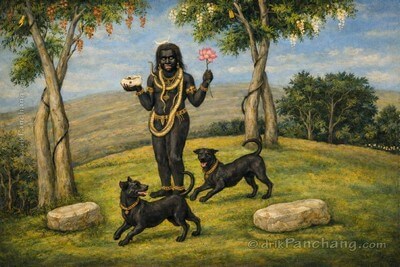
Bhairava Ravivara Vrat is especially beneficial for those who suffer from fear of enemies, unseen obstacles, or incurable diseases, and for those who wish to be freed from planetary afflictions caused by Rahu, Ketu, and Shani. This Vrat is also recommended for protection against Tantra-Mantra and negative energies. Devotees of Lord Kalabhairava observe this Vrat with great devotion and faith to attain strength, courage, and protection in life.
During the Vrat, certain dietary rules are followed to maintain purity of both body and mind. From Saturday night itself, one should abstain from alcohol, smoking, non-vegetarian food, garlic, onion, and other Tamasic foods, and should consume only light and Sattvic food. On the day of the Vrat, the observer should maintain a complete fast throughout the day, or as per family tradition and the guidance of the Acharya, it is appropriate to consume Phalahara.
In Phalahara, it is considered best to consume only pure Sattvic foods such as fruits, milk, water, makhana, peanuts, Sabudana, etc. Those who observe Ekabhukta, i.e., one meal a day should take Sattvic food only after sunset. Excessive or false speech, lust, anger, impurity, and other such vices are considered prohibited during Bhairava Ravivara Vrat.
First, in the morning, take a bath in a river or any sacred water source, or by mixing Gangajal in bathing water, and wear clean clothes. After completing daily rituals, one should take the following Sankalpa by stating the month, Paksha, and Tithi of the Vrat and Puja - "I shall observe the Sunday Vrat and perform Bhairava Puja for the removal of fear from enemies, unseen obstacles, incurable diseases, fulfilment of all desires, and to please Lord Bhairava."
Thus, this simple method of Bhairava Ravivara Vrat is completed.
According to regional beliefs, Bhairava Ravivara Vrat is observed for different durations. Generally, after observing the Vrat regularly for 21, 31, or 51 Sundays, the Udyapana of the Bhairava Ravivara Vrat is performed. The method of Udyapana may vary based on regional and family traditions.
For Udyapana, invite a learned Acharya. As per the Acharya's instructions, take a Sankalpa for the completion of the Bhairava Ravivara Vrat. Recite Bhairava Ashtakam or Bhairava Stotram. Perform Havana with 108 offerings using the Mantra "Om Kalabhairavaya Namah।." In the Havana, use mango wood as Samidha and offer sesame seeds, oil, Urad, and black mustard seeds. After Purnahuti, i.e., the final offering, donate all the Puja materials to the Acharya and offer black cloth, sesame seeds, oil, Urad, etc., along with Dakshina to the Brahmins.
Offer food to all Acharyas and Brahmins. The meal should include dishes made from Urad and sesame seeds, as well as Bajra Khichdi. After the completion of the Puja, respectfully bid farewell to the Acharya and other guests, and then partake of the meal along with family members. Feeding a black dog is also considered essential in Bhairava Ravivara Vrat. Thus, the simple Udyapana Vidhi of Bhairava Ravivara Vrat is completed.
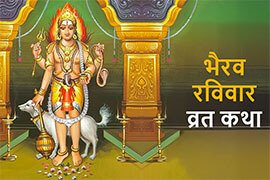
The Vrat Katha related to the manifestation of Lord Bhairava is described. To resolve the dispute of superiority between Lord Vishnu and Lord Brahma, Lord Shiva was incarnated in the form of Bhairava. Bhairava is considered a partial incarnation of Lord Shiva.
Sahasranamavali of Lord Kalabhairava with these names and Mantras is given on this page.
Bhairava Chalisa, dedicated to Lord Bhairava, is given with Hindi lyrics and recitation video. It is recited every Sunday.
The Shri Bhairava Aarti, dedicated to Lord Bhairava, is given with Hindi lyrics. This Aarti is sung during the worship of Lord Bhairava.
The Sahasranamavali of Lord Batuka Bhairava, with the above Mantras, is provided. These Mantras are chanted to receive the blessings of Bhairava Ji.
The Ashtottara Shatanamavali of Lord Bhairava, including the above Mantras, is given. These Mantras are chanted during the Bhairava Sadhana.
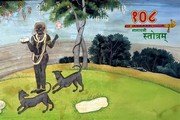
The Batuka Bhairava Ashtottarashatanama Stotram, dedicated to Lord Batuka Bhairava, is given with Sanskrit lyrics and recitation video.
Shri Batuka Bhairava Chalisa, dedicated to Lord Batuka Bhairava, is provided with Hindi lyrics and recitation video. This hymn contains 40 verses.
The very popular Batuka Bhairava Aarti is provided with Hindi lyrics and recitation video. This Aarti is sung during the worship of Shri Batuka Bhairava.