


En


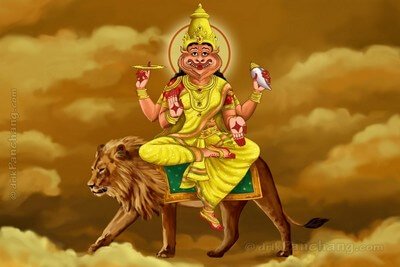
Goddess Narasimhi is revered as one of the Sapta Matrika, the seven divine mothers. Goddess Narasimhi is the divine feminine energy of the Narasimha Avatara of Lord Vishnu. She resembles Lord Narasimha in both form and appearance. Her fierce manifestation invokes dread and terror in the hearts of Her enemies. Goddess Narasimhi is also called Narasimhika and Pratyangira.
In some regions, Chamunda Matrika is included as Sapta Matrika instead of Goddess Narasimhi. In other regions such as Nepal, the Ashta Matrika are worshipped. The worship of Goddess Narasimhi removes all known-unknown fears and sins from the hearts of Her devotees.
The account of the origin of Sapta Matrika is found in numerous sacred texts, including the Varaha Purana. According to these texts, when the demon Raktabeeja, accompanied by legions of other fearsome demons, advanced onto the battlefield to wage the war against Goddess Bhagavati, She let out a thundering ululation, announcing the commencement of the fierce battle.
As soon as the Goddess Bhagavati let out Her resounding war cry, Brahmani Matrika, mounted upon a swan, manifested from Her divine face. From the eyes of Goddess Brahmani, the three-eyed Maheshvari Matrika manifested. From the lion of Maheshvari Matrika, Kaumari Matrika manifested and from the eyes of Goddess Kaumari, Vaishnavi Matrika manifested, mounted upon Garuda. From the back of Goddess Vaishnavi, Varahi Matrika manifested, seated upon the great serpent Sheshanaga and from Her heart emerged Narasimhi Matrika.
Goddess Narasimhi is depicted in Chaturbhuja Rupa, i.e., four-arm form, donning yellow garments. In Her two hands, She carries Sudarshana Chakra and a conch, and Her two remaining hands are raised in Varada Mudra and Abhaya Mudra. Narasimhi Matrika is shown mounted upon a lion. In some other visual representations, Goddess Narasimhi is portrayed carrying a conch, a discus, a trident and a Damaru, like Lord Shiva and Lord Vishnu.
Namaskara Mantra -
नृसिंहरूपेणोग्रेण हन्तुं दैत्यान् कृतोद्यमे।
त्रैलोक्यत्राणसहिते नारायणि नमोऽस्तु ते॥
Nrisimharupenogrena Hantum Daityan Kritodyame।
Trailokyatranasahite Narayani Namoastu Te॥

A detailed description about Goddess Parvati is given here. Goddess Parvati is one of the most popular Goddesses of Hinduism. Goddess Parvati is the consort of Lord Shiva and devotees also call Her by the names Devi Gauri, Devi Uma, Devi Maheshwari etc.
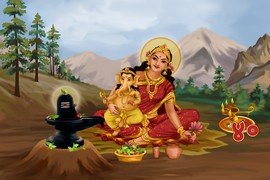
Parvati Mata Chalisa, dedicated to Goddess Parvati, is given with the Hindi lyrics. This Chalisa is recited to seek the blessings of Goddess Parvati.
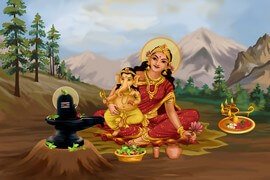
This is the most popular Aarti dedicated to Goddess Parvati. This Aarti is sung during the daily worship of Goddess Parvati and on special occasions related to Her.
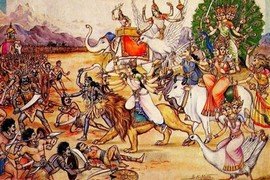
Here is the list Durga Saptashati all chapters. Shri Durga Saptashati is a famous scripture dedicated to Goddess Durga divided into 700 verses and 13 chapters, which originates from the Markandeya Purana written by sage Markandeya. By reciting Durga Saptashati, the seeker attains various Siddhis and finally attains salvation.
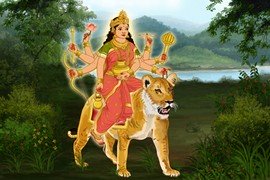
Goddess Durga is one of the five main deities worshipped in Hinduism. Goddess Durga kills enemies and protects Her devotees. Adi Shakti Herself became known as Goddess Durga after killing a demon named Durgama.
Here is the collection of 1000 sacred names of Goddess Durga. These names are also known as Shri Durga Sahasranamavali. By faithfully reciting Shri Durga Sahasranamavali, Goddess Durga get pleased and bestows strength and protect from all kinds of troubles.
Here is the list of 108 names of Goddess Durga, these 108 names are also known as Ashtottara Shatnamavali. These 108 names of Mother Goddess provide peace and joy. Reciting these 108 names daily increases enthusiasm and joy along with the blessings of the Goddess Durga.
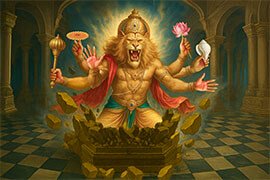
Lord Vishnu took the form of Narasimha to protect His beloved devotee Prahlada and to kill Hiranyakashipu. This is a very fearsome form of Lord Vishnu. Narasimha Avatar is the fourth incarnation of Lord Vishnu out of the ten incarnations.