



En


Maharaja Yudhishthira said - "O Lord! In order to secure the kingdom for me, eighteen Akshauhini (अक्षौहिणी) armies have perished. The thought of this sin is raising the feelings of anguish and remorse in my heart. In that army, Brahmins, Kshatriyas, Vaishyas, and Shudras alike met their death. The deaths of Bhishma, Drona, the Kalingaraja, Karna, Shalya, Duryodhana, and many others are causing immense sorrow in my heart. O Lord of the Universe! Kindly show me a path by which I may attain liberation from these sins."
Lord Shri Krishna said - "O Partha! There is an exceedingly meritorious Vrat known as Govatsa Dwadashi."
Yudhishthira asked - "O Lord! What is this Govatsa Dwadashi Vrat? What is the prescribed method for observing it, and when and how did this Vrat come into practice? O Lord! I am drowning in the ocean of hellish suffering; please protect me."
Lord Shri Krishna said - "O Partha! In Satya Yuga, at the delightful peak named Tantavi on the mountain called Namavratadhara in Bharuch of the sacred Jambumarga region, millions of sages were engaged in severe penance with the desire to behold Lord Shiva. That sacred forest hermitage was adorned with incomparable dense divine forests. There stood the beautiful Ashrama Mandala of Maharishi Bhrigu. The region was inhabited by various kinds of deer and monkeys. Lions and all other wild creatures dwelt there fearlessly and peacefully together.
Once, Lord Shiva became pleased with those sages absorbed in penance and resolved to grant them His Darshana. Assuming the guise of an aged Brahmin, He manifested there to bestow His grace upon the sages. In the form of a frail old Brahmin, trembling while holding a staff in His hand, Shiva arrived at the place where the sages were performing Tapasya. At that very moment, Jagajjanani Mata Parvati also appeared there in the form of a beautiful Savatsa Gau, i.e., cow accompanied by her calf.
O Partha! Listen to the glory and nature of the cow. In ancient times, during the churning of the Kshira Sagara, five divine cows manifested along with Amrita. They became known as Nanda, Subhadra, Surabhi, Sushila, and Bahula. In the scriptures, they are described as Lokamata, i.e., the Mothers of the Worlds. They incarnated for the welfare of the world and for the satisfaction of the Devas. The Devas bestowed these five cows, who grant cherished desires, upon Maharishi Jamadagni, Rishi Bharadwaja, Rishi Vasishtha, Asita Muni, and Gautama Muni.
The six sacred substances of the cow - namely Gomaya, Gorochana, Gomutra, Dugdha, Dadhi, and Ghrita, i.e., Ghee, are considered supremely pure and are means of purification. From cow dung originated the Bilva Vriksha, beloved of Lord Shiva. Padmahasta Goddess Shri Lakshmi resides within the Bilva tree; therefore, it is also called the Shri Vriksha. Lotus seeds too originated from cow dung. Gorochana is exceedingly auspicious, pure, and capable of fulfilling all purposes. From cow urine originated Guggul, which is extremely fragrant and dear. This Guggul is the sacred offering of all the Devas, especially Lord Shiva.
All primordial seeds in the world have originated from cow's milk. All auspicious substances used for sacred purposes have arisen from curd. From Ghee comes Amrita, which satisfies the Devas. Brahmins and Gau, i.e., cows, are two parts of the same lineage. The Vedic Mantras reside in the hearts of Brahmins, while Havi, i.e., sacrificial oblations dwell in the hearts of cows. Yajna itself proceeds through the cow, and all the Devas are established within her. The entirety of the Vedas, along with their six limbs, is contained within the cow.
At the root of the cow's horns reside Brahma and Vishnu eternally. At the tips of the horns are established all moving and unmoving beings and all sacred Tirthas. Mahadeva Shiva, Lord of the Devas, resides in the middle of the horns. On the forehead of the cow dwells Devi Gauri; in the nostrils resides Kartikeya; and in the two nasal passages abide the two serpents named Kambala and Ashvatara. The Ashwini Kumaras dwell in the ears; the Chandra and Surya in the eyes; the eight Vasus in the teeth; Varuna in the tongue; Saraswati in the palate; Yama and the Yakshas in the cheeks; the two Sandhyas in the lips; Indra in the neck; Rakshasas in the hump; Dyau in the heels; and Dharma, along with its four legs, in the thighs. Gandharvas reside between the hooves; Sarpa (serpents) in the forepart; and Rakshasagana (demons) in the hind portion.
On the back of the cow reside the Ekadasha Rudra; Varuna resides in all the joints; the Pitris dwell in the waist; humans in the cheeks; and Shri, adorned in the form of Swaha, resides in the lower region. Adityarashmi, i.e., the rays of the Surya are established in clusters within the hairs. The sacred Ganga resides in cow urine, and Yamuna in cow dung. Thirty-three crore deities dwell within the hair follicles of the cow. The Prithvi, along with forests and mountains, abides in her abdomen. The four Maha Samudra, i.e., great oceans reside within her udders. Clouds, rain, and drops of water dwell within the streams of milk. Garhapatyagni resides in the stomach, Dakshinagni in the heart, Ahavaniyagni in the throat, and Sabhyagni in the palate. Mountains dwell in the bones of cows, and Yajnas in their marrow. All the Vedas too are established within cows.
O Yudhishthira! Bhagavati Uma remembered the form of those Surabhi cows and assumed a similar form Herself. Elevated in six places and lowered in five, frog-eyed, possessing a beautiful tail, reddish udders like copper, a shining waist like silver, beautiful hooves and face, fair-complexioned, gentle in nature, affectionate toward her calf, yielding sweet milk, possessing beautiful udders, and endowed with all auspicious marks, Goddess Uma in the form of a cow with her calf was joyfully being grazed by Lord Shiva, who had assumed the form of an aged Brahmin. O Partha! Gradually Lord Shiva entered that Ashrama and, before Kulapati Bhrigu, entrusted that cow to Rishi Bhrigu for safekeeping for two days.
While entrusting the cow, Lord Shiva in the form of a Brahmin said - 'O Muni! I will bathe here and then depart for Jambu Kshetra. I will return after two days. Until then, please protect this cow.'
The sages assured Him by vowing to protect the cow in every possible manner. Lord Shiva then disappeared from that place. After some time, Lord Shiva reappeared there in the form of a Vyaghra, i.e., tiger and began terrifying the cow and her calf. The sages too cried out in distress due to fear of the tiger and tried with all their strength to drive it away. Frightened by the tiger, the cow with her calf leapt about and mooed loudly.
O Yudhishthira! In her terror while fleeing from the tiger, the marks of the cow's four hooves became imprinted upon a rock. In the heavens, the Deva and Kinnara praised and worshipped the tiger, i.e., Lord Shiva and the cow with her calf, i.e., Goddess Parvati. Those marks upon the rock remain clearly visible even today. The place where those hoof marks exist is a sacred Tirtha of the holy Narmada Ji. Whoever touches the Shiva Linga of Shambhu Tirtha becomes freed from the sin of Gohatya, i.e., cow slaughter. O King! Bathing in that great Tirtha situated in Jambumarga liberates one from sins such as Brahmahatya.
When the cow with her calf became terrified by the tiger, the sages, enraged, began ringing a fearsome bell received from Brahma. Hearing the sound of that bell, the tiger departed, leaving the cow and her calf behind. The Brahmins named that place Dhundhagiri. O Partha! Those who behold it undoubtedly become Rudra-like themselves.
After some moments, Lord Shiva abandoned the tiger form and manifested there directly. He was mounted upon Vrishabha, i.e., the bull. Bhagavati Uma was seated on His left side, and He was surrounded by Vinayaka, Kartikeya, Nandi, Mahakala, Shringi, Virabhadra, Chamunda, Ghantakarna, and many others. Matrikas, Bhutagana, Yaksha, Rakshasa, Guhyaka, Deva, Danava, Gandharva, Muni, Vidyadhara, Naga, and their wives were all worshipping Lord Shiva. Even the Sanakadi sages were engaged in His worship.
O King! On the Dwadashi Tithi of the Kartika Shukla Paksha (according to another tradition, Krishna Paksha), the Brahmavadi sages devotedly worshipped Goddess Uma in the form of a cow with her calf under the name Nandini. Therefore, Govatsa Dwadashi Vrat is observed on this day. From that very time, this Vrat became popular upon Earth. Now listen to how King Uttanapada propagated this Vrat in the Prithvi Loka -
In ancient times, there was a Kshatriya king named Uttanapada. He had two queens named Suruchi and Shughni, also known as Suniti. From the womb of Suniti was born a son named Dhruva. Entrusting her son to Suruchi, Suniti said - 'O friend! Please protect this child. I will remain ever engaged in serving my husband.'
Thus, Suruchi constantly managed the household, while the devoted Suniti remained engaged in serving her husband. Once, overcome by jealousy toward her co-wife and driven by anger and envy, Suruchi killed Suniti's child. However, by divine providence, the child immediately came back to life and sat laughing joyfully in his mother's lap. In the same way, Suruchi made many attempts to kill the child, but each time he came back to life again and again.
Seeing the child alive, Suruchi became astonished and asked Suniti - 'O Devi! What is this strange occurrence? By the power of which Vrat has this happened? What kind of Havana or Vrat have you performed, by whose merit your son repeatedly comes back to life? Have you mastered the Mritasanjivani Vidya? What gem, great gem or special knowledge do you possess that causes this miracle? Tell me truthfully.'
Suniti replied - 'O sister! I observed the Govatsa Vrat on the Dwadashi day of Kartika month. By the merit of that Vrat, my son repeatedly comes back to life. Whenever I remember him, he appears before me at once. Even one living far away may obtain a son through the power of this Vrat. O Suruchi! By observing this Govatsa Dwadashi Vrat, you too shall obtain everything and attain welfare.'
Following Suniti's advice, Suruchi also observed this sacred Vrat. By the merit of this Vrat, Suruchi too obtained a son, wealth, and happiness. Creator Brahma established Suruchi along with her husband Uttanapada, and even now she remains joyful. Dhruva, associated with the ten Nakshatras, is still visible in the heavens today. By beholding Dhruva Nakshatra, one becomes freed from all sins."
Yudhishthira said - "O Lord! Kindly also describe the proper method for observing this Vrat."
Lord Shri Krishna said - "O great among the Kurus! During the Dwadashi of the Shukla Paksha in Kartika month, one should bathe in a water reservoir after taking a Sankalpa and should eat only once during the day. Thereafter, at midday, one should worship a cow along with her calf using fragrance, flowers, Akshata, Kumkum, Alaktaka, Diyas, flower garlands, and Urad Vadas while reciting the following Mantra -
ॐ माता रुद्राणां दुहिता वसूनां स्वसादित्यानाममृतस्य नाभिः।
प्र नु वोचं चिकितुषे जनाय मा गामनागामदितिं वधिष्ट नमो नमः स्वाहा॥
Om Mata Rudranam Duhita Vasunam Svasadityanamanritasya Nabhih।
Pra Nu Vocham Chikitushe Janaya Ma Gamanagamaditim Vadhishta Namo Namah Svaha॥
After the worship, offer fodder to the cow and, while touching her, pray and seek forgiveness with the following Mantra -
ॐ सर्वदेवमये देवि लोकानां शुभनन्दिनि।
मातर्ममाभिलषितं सफलं कुरु नन्दिनि॥
Om Sarvadevamaye Devi Lokanam Shubhanandini।
Matarmamabhilashitam Saphalam Kuru Nandini॥
After worshipping the cow in this manner, sprinkle her with water and bow before her with devotion. On this day, one should not consume food cooked on an iron griddle and should sleep upon the ground while observing Brahmacharya. A devotee who faithfully observes this Vrat enjoys all forms of happiness throughout life by the merit of this sacred observance, and at the end of life dwells in Goloka for as many years as there are hairs upon the cow's body. There should be no doubt about this."
॥Thus concludes Govatsa Dwadashi Mahatmya described in Uttaraparva of the Bhavishya Purana॥
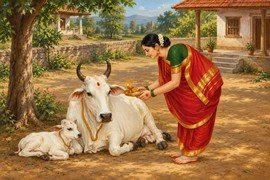
According to the Hindu Panchang, Govatsa Dwadashi is celebrated one day before Dhanteras. On this sacred occasion, cows and their calves are worshipped with devotion. Govatsa Dwadashi Vrat is also known as the Nandini Vrat. On this day, the use of cow's milk-based products is strictly prohibited.
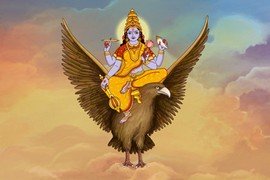
A complete list of Ekadashi dates is given here. Go through the Ekadashi fasting dates list here so that you never miss fasting on Ekadashi. Ekadashi fast is observed with great enthusiasm by the devotees of Lord Vishnu.
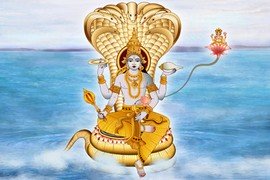
ISKCON devotees can get the complete list of ISKCON Ekadashi fasting dates here. This list will prove highly informative and useful to those who observe the fast of Ekadashi as per the ISKCON.
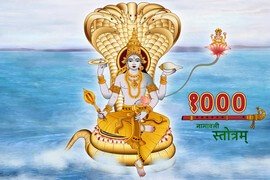
Shri Vishnu Sahasranama Stotram containing 1000 names of Lord Vishnu is given with Sanskrit lyrics and recitation video. This Stotram is recited on various occasions of Vishnu Ji including Ekadashi.
Mantras and names of Lord Vishnu, known as Sahasranamavali is given with meaning and recitation video. These Mantras are chanted on various occasions including Ekadashi.
Shri Vishnu Ashtottarashatanama Stotram described in Padma Purana dedicated to Lord Vishnu, is given with lyrics and recitation video. Devotees of Lord Vishnu recite this Stotram with great devotion.
Above list of Lord Vishnu's sacred names and Mantras is given with their meanings and recitation video. This Shatanamavali is derived from the Padma Purana.
Shri Vishnu Chalisa is given with Hindi lyrics and recitation video. Vishnu devotees recite this Chalisa every day. It is called Chalisa because it consists of 40 Chaupayi(s).
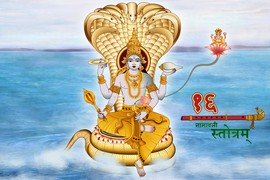
Shri Vishnu Shodashanama Stotram containing 16 names of Lord Vishnu is given with Sanskrit lyrics and recitation video. This Stotram is recited on various occasions of Vishnu Ji including Ekadashi.
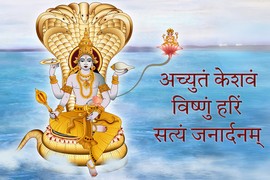
Shri Vishnu Namashtakam dedicated to Lord Vishnu is given with lyrics and recitation video. Reciting this Ashtakam containing the eight holy names of Lord Vishnu brings blessings from Him
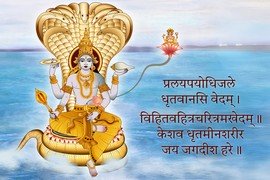
The given Shri Vishnu Dashavatara Stotram is a very melodious and effective Stotram dedicated to the ten incarnations of Lord Vishnu.
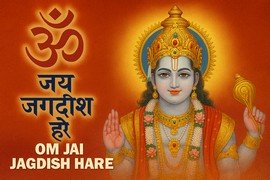
The most popular Jai Jagdish Aarti dedicated to Lord Vishnu is given with Hindi lyrics and recitation video. This Aarti is sung during the daily worship of Lord Vishnu.

The list of Mantras used in the worship and chanting of Lord Vishnu is available on this page. Some of these Mantras are legendary and some are Vedic. Along with this, the powerful Yantra of Lord Vishnu can also be seen from this page.
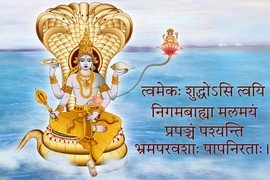
Shri Parameshwara Stuti Stotram is a very important Stotram dedicated to Lord Vishnu. Devotees recite this Stuti to obtain the grace of Lord Vishnu.