



En




Sage Durvasa said to Satyatapa Vyadha - "Listen to the merit obtained by observing the Kalki Dwadashi Vrat, just like the previously described Vrats.
In ancient times, in the city of Kashipuri, there was a highly valiant and brave king named Vishala. In the course of time, people of his own lineage deceitfully deprived him of his kingdom and all his wealth and prosperity. After losing his kingdom, King Vishala went to reside in the sacred Badarivan region situated on Gandhamadana Parvata and began performing penance.
The king was deeply absorbed in sincere and severe penance when one day, by divine coincidence, two divine sages named Nara and Narayana arrived there. These Nara-Narayana are renowned in all the worlds; all the Devas bow to them repeatedly, and all become powerless before their radiance. Those divine beings, Nara and Narayana, thought within themselves - 'This king has long been meditating and performing penance upon Lord Vishnu, Parabrahma Paramatma, i.e., the Supreme Absolute. Therefore, his desire should be fulfilled.'
Thinking thus, both of them approached King Vishala and said - 'O King! We are greatly pleased with your devotion and penance towards the Supreme Lord. Therefore, for your welfare, we have come to grant you a boon. Ask from us any boon according to your desire.'
King Vishala said - 'O sages! I don't know who you both are. Therefore, before whom should I seek a boon? My wish is to receive a boon only from my Param Aradhya, i.e., Supreme Lord, whom I worship and adore.'
Upon hearing this, Nara and Narayana said - 'O King of kings! Whom do you worship? Who is your chosen deity, and what boon do you desire? We wish to know this; tell us.'
King Vishala said - 'I worship Lord Vishnu.' Saying this, the king fell silent. Seeing this, Nara and Narayana again said - 'O King! It is by the supreme grace of that very Lord Vishnu that we have come to grant you a boon. Tell us the desire of your heart.'
The king said - 'O Lord! I wish to perform Yajnas accompanied by various offerings of Dakshina and worship Lord Yajneshwara. Kindly fulfill this desire of mine as a boon.' At that moment, both Lord Nara and Lord Narayana were present before the king.
Hearing the words of the king, Lord Nara said - 'This is Lord Narayana! He alone primarily guides the entire Charachara, i.e., moving and non-moving universe. He Himself is skilled in the creation of the universe and has come to this forest with me for the purpose of penance. He is that very Lord Shri Hari who, in earlier times, has incarnated as Matsya, Varaha, Narasimha, Vamana, and Parashurama. His power is limitless, and He is omnipotent. He is the same God who incarnated as King Shri Ramachandra, the son of King Dasharatha. In that incarnation, His form and beauty were extremely captivating. At that time, He destroyed unrighteous demons and relieved the Earth of its burden.
In earlier times, upon the prayers of human beings, He manifested as Narasimha. To protect the Devas from King Bali, He incarnated as Vamana, and to obtain the kingdom from the Kshatriyas, He appeared as Parashurama. To destroy cruel and sinful enemies, that same Lord Narayana manifested as Shri Krishna. Therefore, learned people worship this Supreme Being alone.
A wise person should worship the Bala Rupa, i.e., child form of Lord Krishna for the desire of a son. Those who desire beauty should worship the Buddha incarnation of Lord Vishnu, and those who wish for the destruction of enemies should worship the Kalki incarnation. There is no doubt whatsoever in this principle.'
After praising the glory of Lord Narayana in this manner, Devarshi Nara instructed King Vishala about the Bhadrapada Shukla Dwadashi Vrat. Following the instructions of Sage Nara, the king devoutly observed the Dwadashi Vrat according to proper Vidhi-Vidhana, i.e., rituals and procedure, as a result of which he became established in the world as a universal emperor."
Sage Durvasa says - "O sage! It is because of that very King Vishala that this Badarivan became renowned in all the worlds as Badri Vishala. That excellent king enjoyed all kinds of royal pleasures throughout his life, and at the end of his life, he went to Badarivan. After performing various divine Yajnas there, he attained Param Pada, i.e., the supreme abode of Lord Shri Hari."
॥Thus concludes Kalki Dwadashi Vrat Mahatmya described in the Shri Varaha Purana॥
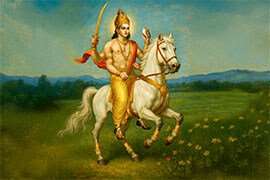
Shukla Dwadashi of the Bhadrapada month is known as Kalki Dwadashi. On this day, devotees worship Lord Vishnu and His future incarnation, Kalki. Scriptures describe that at the end of Kaliyuga, Lord Vishnu will incarnate as Lord Kalki to restore Dharma.
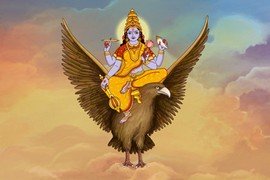
A complete list of Ekadashi dates is given here. Go through the Ekadashi fasting dates list here so that you never miss fasting on Ekadashi. Ekadashi fast is observed with great enthusiasm by the devotees of Lord Vishnu.
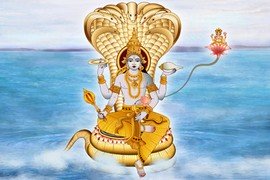
ISKCON devotees can get the complete list of ISKCON Ekadashi fasting dates here. This list will prove highly informative and useful to those who observe the fast of Ekadashi as per the ISKCON.
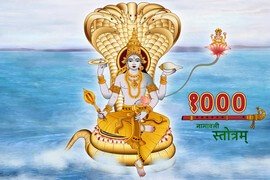
Shri Vishnu Sahasranama Stotram containing 1000 names of Lord Vishnu is given with Sanskrit lyrics and recitation video. This Stotram is recited on various occasions of Vishnu Ji including Ekadashi.
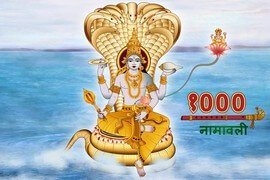
Mantras and names of Lord Vishnu, known as Sahasranamavali is given with meaning and recitation video. These Mantras are chanted on various occasions including Ekadashi.
Shri Vishnu Ashtottarashatanama Stotram described in Padma Purana dedicated to Lord Vishnu, is given with lyrics and recitation video. Devotees of Lord Vishnu recite this Stotram with great devotion.
Above list of Lord Vishnu's sacred names and Mantras is given with their meanings and recitation video. This Shatanamavali is derived from the Padma Purana.
Shri Vishnu Chalisa is given with Hindi lyrics and recitation video. Vishnu devotees recite this Chalisa every day. It is called Chalisa because it consists of 40 Chaupayi(s).
Shri Vishnu Shodashanama Stotram containing 16 names of Lord Vishnu is given with Sanskrit lyrics and recitation video. This Stotram is recited on various occasions of Vishnu Ji including Ekadashi.
Shri Vishnu Namashtakam dedicated to Lord Vishnu is given with lyrics and recitation video. Reciting this Ashtakam containing the eight holy names of Lord Vishnu brings blessings from Him
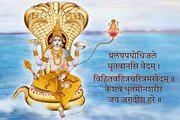
The given Shri Vishnu Dashavatara Stotram is a very melodious and effective Stotram dedicated to the ten incarnations of Lord Vishnu.
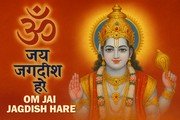
The most popular Jai Jagdish Aarti dedicated to Lord Vishnu is given with Hindi lyrics and recitation video. This Aarti is sung during the daily worship of Lord Vishnu.
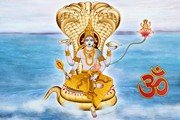
The list of Mantras used in the worship and chanting of Lord Vishnu is available on this page. Some of these Mantras are legendary and some are Vedic. Along with this, the powerful Yantra of Lord Vishnu can also be seen from this page.
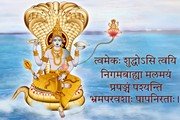
Shri Parameshwara Stuti Stotram is a very important Stotram dedicated to Lord Vishnu. Devotees recite this Stuti to obtain the grace of Lord Vishnu.